Archive for the ‘Acquiring Customers’ Category

Nov 30th 09

Milestones to Startup Success

Update added to end of post

When your startup accepts outside money (such as venture capital), you are obligated to focus on maximizing long-term shareholder value.  For most startups this is directly based on your ability to grow (customers, revenue and eventually profit).  Most entrepreneurs understand the importance of growth; the common mistake is trying to force growth prematurely.  This is frustrating, expensive and unsustainable – killing many startups with otherwise strong potential. 

Most successful entrepreneurs have a good balance of execution intuition and luck.  This was definitely the case at the two startups where I ran marketing from launch through NASDAQ IPO filings.  While we didn’t follow a specific methodology, our CEO was intuitive enough to know the right time to “hit the gas pedal.”  We didn’t accelerate until verifying that the team had created a great product that met real customer needs and we could generate sufficient user revenue to support sustainable customer acquisition programs.  It’s taken years for me to realize that our growth was less a function of clever marketing tactics than beginning with something that customers truly needed.  Some growth would have been automatic; the marketing team simply accelerated this growth.

Several startups later I have a much better understanding of the key milestones needed for a startup to reach its full growth potential.  These are based more on observing universal truths than inventing some type of methodology.  Reaching the full growth potential of your startup requires focus, specifically focusing on what matters when it matters.  In my post on the startup growth pyramid I talk about the high level milestones you must achieve in order to unlock sustainable growth.  This post looks at it on a more granular level with links to several of my previous blog posts and other resources that provide additional details.

Day 1: Validate Need for Minimum Viable Product (MVP)

Before any coding begins it is important to validate that the problem/need you are trying to solve actually exists, is worth solving, and the proposed minimum feature set solves it.  This can best be achieved by meeting with the prospects most likely to need your solution.  Steve Blank published a great post on this today.

Eric Ries offers more details on the minimum viable product concept in this post/video

Where’s the Love?

Vinod Khosla, one of the most successful Silicon Valley VCs in history, once suggested to me that startups should think of their early users as a flock of sheep.  He explained “the flock always finds the best grass.” 

For you this means you should start looking for a signal about who loves your product and why as soon as you release your MVP.  Most products have at least a few people that truly consider it a must have.  These people hold the keys to the kingdom.  Learn everything you can about them including their specific use cases and demographic characteristics.  Try to get more of these types of people.

A good place to start collecting this information is the survey I’ve made freely available on Survey.io (a KISSmetrics product).    You can read more about this product/market fit survey in this blog post

If you’re lucky you’ll be able to use this early signal to find the product/market fit.

Expose the Core Gratifying Experience

The majority of our project focus at 12in6 recently has been helping startups find their core user perceived value and exposing it in messaging optimized for response.  Your objective should be to remove complexity from the initial user experience and messaging in order to highlight this core user perceived value.  Often this means burying or even completely eliminating features that don’t relate to this gratifying experience.

Metrics

Metrics don’t matter until you achieve product/market fit – then they are critical to your success.  Dave McClure has a great video on startup metrics that matter (relevant part is at about minute 2:20). 

Most of the tools out there provide way too many irrelevant metrics and miss the essential few.  Both Dave McClure and I are advising KISSmetrics on a solution to this problem.

Start Charging

Another key step before growing your business is to implement a business model.  The ideal timing for implementing your business model is discussed in this blog post

I’ve often heard the argument that startups are focused on user growth and prefer to delay revenue in the short term.  I believe the fastest way to grow is with a business model and explain why in this blog post.

Extreme Customer Support

Now that you have a business model in place, your first marketing expense should be to expand the customer support team.  Anyone that cares enough about your solution to contact customer support is a great source of insight about your target market.  Also, customer support will uncover issues that will help you grow faster without spending.  And fixing these issues will make it much easier to grow when you do start spending. 

If your customer support team is overwhelmed now, I don’t recommend trying to grow until you address the issues driving most support calls. Once you’ve addressed these issues you’ll have fewer barriers to adoption and will be able to grow without overwhelming customer support. 

This will enable customer support to go above and beyond expectations, which is an important way to drive customer loyalty and enhance word of mouth.  This approach pays more dividends today than ever before – as I explain in this post on Social Media

Update: See comments for additional thoughts on extreme customer support.

Brand Experience Over Brand Awareness

Back in the “Dotcom Bubble” days billions were wasted on brand awareness campaigns for startups.  Today most entrepreneurs understand that brand awareness campaigns are a waste of money for startups.

Instead, it’s much cheaper and more effective for startups to focus on creating a fantastic brand experience.  While startups often realize the importance of brand experience, they focus on it too early, fine tuning things that customers don’t care about.  Instead, wait until you understand why certain customers love your product; then obsess over every element of this customer experience. 

Apple is probably the best tech company out there on coordinating a perfect brand experience for its target users. I cover more on brand experience in this blog post

Driving Growth

Once you’ve achieved all of the previous milestones, then you can focus on driving growth.  CEOs must take an active role in driving customer growth whether or not they have an interest in marketing. Nearly all of the risk and upside in a startup is in your ability to gain customer traction and then drive scalable customer growth. The CEO should not abdicate this responsibility to the marketer.

It’s important to stay aggressive and take all slack out of the market (make it completely uninteresting to pursue the market for any other competitor).  Your early advantage is the ability to iterate on the customer feedback loop and leverage strong customer loyalty to drive word of mouth.

While ROI lets you know if a user acquisition channel is sustainable, the key focus should be on exposing lots of the right people to your fantastic product experience.  It’s much easier to get passionate and creative about this than purely thinking about things from an ROI perspective. Of course positive ROI is essential for any customer acquisition program to remain in the mix.

When it’s time to hire a marketing leader to partner with the CEO, this post explains my recommendations for an ideal startup marketing leader.  The most effective startup marketers are relentless about experimenting with channels until finding things that work. 

Start by building out free channels such as listing in directories and basic SEO.   When you begin building paid channels, extra effort should be put into channels that show strong potential for scale. 

Unfortunately you can’t count on effective online tactics working forever.  I’ve seen many hot online marketing tactics lose their effectiveness over time.  This is because online tracking makes it easier for marketers to quickly figure out what actually works.  As a result we start piling into the most effective tactics.   Eventually online tactics get saturated, as explained in this post

Business building

Fast growing businesses are difficult to manage.  This is the point where you should bring in some experienced operations people if they aren’t already on the team. 

It Won’t be Easy

Finally, the top three risks to growing via these milestones are:

  1. You lose patience and decide that one or more of the milestones really aren’t that important.
  2. VCs and/or board of directors lose patience because you did not achieve conceptual agreement on this approach from beginning.
  3. You delude yourself into believing that for “our type of business” customers really don’t need to consider our product a “must have”.  For us, “nice to have” is good enough.

Building a successful business is hard.  Hopefully this milestone driven approach to growing your startup will make it a bit easier.

Update: It’s hard to write a blog post on “milestones to startup success” that covers every type of startup.  Some startup types may need to reverse the order of some of these milestones.  For example, with marketplaces (EBay, social networks, eduFire, dating sites, etc.) user gratification increases with more users so there is a bit of chicken and egg here…  Ad supported sites also benefit from early scale. Many of the articles linked to from this blog post also cover exceptions such as when a startup should start charging (it’s different for enterprise targeted startups).
Posted in 12in6, Acquiring Customers, Branding, Building Awareness, Business models, Competitors, Customer Development, Hiring, Positioning, Product/market fit, Steven Blank, VC, Venture Capital, word-of-mouth
56 comments

Oct 7th 09

Founders Make the Best Startup Marketing Leaders

CEOs often ask for my advice on the ideal candidate profile to lead their ongoing customer growth efforts once we’ve completed the key steps to unlocking growth. You would think that after running marketing at two startups through IPO filings that I could easily answer that question. But I’ve struggled to define the ideal profile of a successful startup marketing leader. After many course corrections, I finally believe I have it figured out. But to really understand the ideal profile, it is important to comprehend why the role is so challenging.

Based on anecdotal evidence, I’d guess that 90% of startup marketing leaders don’t work out. This corresponds to the overwhelming majority of startups falling short of expectations of founders and early investors. When a startup falls short of expectations, the startup marketing leader is the first to go. Even those fortunate enough to gain early user traction still face the uphill battle of finding cost effective ways to acquire users at scale. And if they do succeed, then startups are often tempted to hire a “next level marketer” to replace them.

A successful startup marketing leader must be undaunted by these risks and believe they uniquely have what it takes to succeed. That sounds a lot like the profile of most startup founders. So it’s not surprising that the best startup marketers are entrepreneurs at the core. Entrepreneurs are willing to take the risk and are generally tenacious enough to uncover the channels necessary to drive long-term growth.

I came to this conclusion after finding the common thread between myself and the two most effective people I’ve met at uncovering growth channels. One is still CEO of his company but has done more to drive customer adoption with a fraction of his time than most startup marketers do with undivided attention. The other highly effective startup marketer is a founder that transitioned to leading marketing. They share a persistent desire to connect their innovative solutions with the people that really need them. After implementing critical tracking systems and an efficient customer acquisition process, they are now relentless about experimenting with channels until they find things that work.

Contrast this to a typical marketer, who is generally more focused on marketing activities than marketing results. Most of these activities do nothing to move the needle on the business, but make the marketer feel good because they are working hard.

It may be tempting for a startup CEO to read this and think that aggressive targets can steer the marketer in the right direction. I don’t think that will work. Effective marketing leaders will challenge themselves by pushing the boundaries of the startup’s growth potential. The CEO should be a partner in this process rather than setting arbitrary unrealistic goals. If you don’t have confidence in your marketing leader, the founding CEO should micromanage the process by being an active participant in channel brainstorming sessions and challenging the marketer to ensure tests have been implmented to perfection. Once you have created a product that people really want, most of the remaining company risk and upside lies in your ability to aggressively drive customer adoption. This is not something a CEO should abdicate to the marketer until they’ve demonstrated a relentless drive to uncover profitable customer acquisition channels.

The CEO can also facilitate channel discovery by ensuring that the marketing leader gets the tracking systems they need to execute marketing efficiently. Of course the marketer should be able to make a case for why these resources are important.

What about successful startups that had an initial marketing leader with a more traditional background? First, there is nothing wrong with a traditional marketing background if at the core the marketer is entrepreneurial. Second, the marketer does not always deserve credit for strong user growth. Sometimes great products really do market themselves. My experience with Dropbox certainly supports this assertion. Also, I recently spoke to the former VP Marketing at a company that sold for billions and he agreed that his most important growth contribution was not getting in the way of the viral growth engine.

Of course the risk in hiring an entrepreneur to lead your marketing is that they’ll eventually leave to start their own company. Agree that this is an acceptable outcome if they are willing to give you at least a couple years.

Finally, only the marketing leader needs to be entrepreneurial. In my experience, it is not an essential characteristic for the rest of the marketing team.

Posted in Acquiring Customers, Hiring
12 comments

Jun 18th 09

Big Picture Customer Development Revisited

Working with four startups at the same time has steepened my customer development learning curve (and also explains why it has been a month since my last update).   To help balance the load, I’ve brought on a conversion designer and a researcher; we’re finally firing on all cylinders. 

Our customer development goal with every startup essentially boils down to a race to be able to focus on growing the business.  But in order to avoid wasting effort and money on tactical growth drivers, the following steps need to be completed first:

  • Validate the product/service is gratifying a reasonable percentage of users.
  • Create a value proposition that will attract the right type of users and pull them through the conversion funnel to gratification (and ultimately a transaction). 
  • Eliminate friction from the conversion funnel. 
  • Fine tune a business model that supports scalable customer acquisition channels. 

If these steps have been executed well it is relatively easy to grow a sustainable business.  But many startups skip these steps and jump right into trying to grow the business – making their job much harder or even impossible.  Some will get lucky, but most will fail.  

Given the importance of getting customer development right, I’m certain that eventually most startups will contract a specialist to help them navigate the challenges of this pre-scale phase.  I’m often asked how I plan to expand 12in6 to help more startups.  Most people are surprised when I tell them I don’t have a desire to expand the business.  I really enjoy being able to work hands on with two new startups per quarter.  If I built a large team to fill the current void of specialists, I’d be too busy managing the team.  This would mean less time learning how to improve my customer development approach. 

As I explained in my last post, I’m now validating that a startup’s product is gratifying users before I commit to working with them.  While I love to hear from as many funded startups as possible, I can barely scratch the surface of the number of startups that need help.  If I don’t have the capacity to help you, here are a few others that specialize in customer development:  (I haven’t dug into their approach enough to be able to endorse them, but I encourage you to check them out)

If you are specializing in customer development or know someone else that you can recommend, please add names/recommendations in the comments. The main things to consider when evaluating a specialist is their track record building successful companies.  And be sure to check references (especially around chemistry with the team).

I have been sharing discoveries on Twitter (follow me @ http://twitter.com/seanellis) and hopefully  I’ll resume regular blog posts next week (after I get back from a short vacation in Hawaii).

Posted in 12in6, 12in6 Methodology, Acquiring Customers, Customer Development
8 comments

May 18th 09

Free Customer Development Help – Survey.io

I’m excited to announce a project that I’ve been working on with KISSmetrics called Survey.io, which provides startups with a free and easy way to prepare, distribute and analyze an initial customer development survey. It includes the content of the survey I use to verify that a startup is ready for the 12in6 Metrics Driven Customer Development Program (which begins at the validation step in Steve Blank’s Four Steps to the Epiphany). 

Determine if you are ready to scale

For startups, this survey is an ideal way for you to determine if you should begin the final preparations before aggressively scaling customer acquisition.  Some VCs have also started using Survey.io as part of their diligence before making Series B investments – so don’t be surprised if a VC asks you for your Survey.io results.

The most important question for determining how well your product is resonating with early users is question 2:

2) How would you feel if you could no longer use [product]?

  • Very disappointed
  • Somewhat disappointed
  • Not disappointed (it isn’t really that useful)
  • N/A – I no longer use [product]

If most of your respondents are saying that they would only be “somewhat disappointed” without your product, they are really telling you that it is only a “nice to have”.  When asking users why they selected this answer, I often find that they are focused on commodity aspects of the product and they know of a replacement product.  It’s very difficult to build a business around a “nice to have” product, so you should keep burn and customer flow low while you iterate your core experience. 

If however, you find that around 50% or more of your users are saying that they would be “very disappointed” without your product, there is a great chance you can build a successful business on this “must have” product.  This is the time to reallocate some development resources to optimizing first time user flows and building the tracking/reporting systems needed to effectively scale customer acquisition initiatives. 

Survey.io to develop value proposition

The survey also provides some useful early feedback for verifying use cases, developing your value proposition and positioning against the most common alternative solutions.  This feedback is directionally useful, but I recommend significantly more research (via customer surveys and interviews) before finalizing your value proposition and positioning.

I strongly encourage you to setup and run your own customer development survey via Survey.io.  It only takes a few minutes and it free.  Here’s the link again.

And here’s a link to my customer development survey for Startup-Marketing.com .  I’d really appreciate it if you could take the time to complete it.  This will help me tailor the content of this blog to better meet your needs.

Posted in 12in6, 12in6 Methodology, Acquiring Customers, Competitors, Customer Development, Research, Steven Blank, The Four Steps to the Epiphany, VC
3 comments

May 4th 09

Keys to Unlocking Startup Growth

When a startup takes VC funds, they usually accept the premise that they need to “get big fast”.  VCs don’t fund lifestyle businesses.

Unfortunately desire for growth causes many startups to make poor choices.  There are generally two opposite mindsets that lead to the same mistakes:

  1. Overconfidence: “We have lots of money, so let’s move fast (no need to be cautious).”
  2. Panic: “We are running out of money, so let’s move fast (get traction before we run out).”

For an entrepreneur focused on growth, it seems natural that they should “get the word out” about their new innovative solution. Thus many startups quickly launch awareness building initiatives ranging from advertisements in a tech magazine to exhibiting at tradeshows.   Generally this is a complete waste of money.

While experienced marketers recognize the need for some positioning work upfront, they still generally lack a broader understanding of where to focus resources and in which order. 

The first time I saw an effective go to market roadmap was when I read Steve Blank’s Four Steps to the Epiphany.  His roadmap consists of the following four steps:

  1. Customer discovery
  2. Customer validation
  3. Customer creation
  4. Scale company

He warns that a company should not kick into growth mode until reaching the fourth step.  By this point they have figured out a sustainable and scalable process for acquiring and monetizing customers.  If you haven’t read the book, I highly recommend it.  For a more detailed overview of the book see this post from Eric Ries.

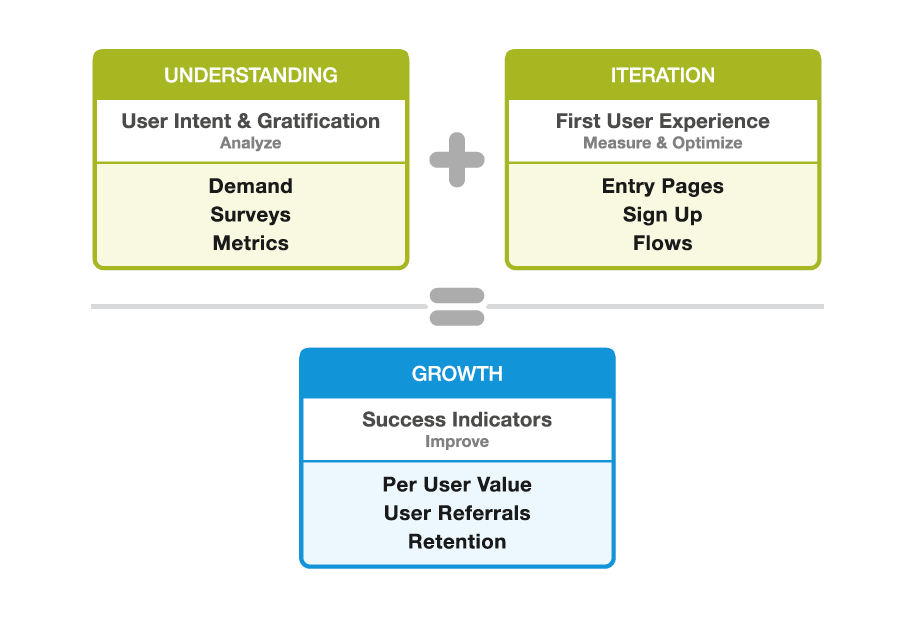
The approach I’ve used to attract 10s of millions of users to startups is similar, but allows growth a little earlier (click graphic below for full size).  

unlocking-growth
 
Within a few weeks of initiating the understand phase, we generally have enough user insight to baseline allowable acquisition costs of a new user and begin iterating.  It can be tempting to start building all customer acquisition channels that fall within this allowable acquisition cost, but finding and managing these channels takes too much time to already be a priority.  Instead, we just want to generate enough new user volume to iterate landing pages and sign up flows.  These iterations can increase the allowable acquisition cost by more than 10X in only a few months. 

At the completion of the iteration phase we can put all of our energy into building profitable customer acquisition channels.  With a much higher allowable acquisition cost, the process of building profitable channels is relatively easy (and even fun).  I recommend starting with free channels first and ultimately spending up to your allowable acquisition cost.  This recent post gives more details on building these channels.

Posted in Acquiring Customers, Customer Development, Steven Blank, The Four Steps to the Epiphany
2 comments

Apr 20th 09

To Pay Or Not To Pay To Acquire Users?

I recently heard a VC say that startups “should spend the least amount of money possible on marketing.”  This is a healthier attitude than the opposite prescription of undisciplined land grab, but a better approach is pure ROI marketing.  Marketing opportunities that offer a fast payback with additional profit margin are a key component for reaching your startup’s full market potential.

Work from Free to Paid Drivers

Ultimately my goal with any startup is to acquire the highest number of qualified users possible – at a positive return on investment.  But it often takes several months after “launching” to transition to aggressive scaling. 

I like to start with free customer acquisition channels since they obviously offer the best opportunity to generate a positive ROI. Free drivers may include viral marketing, self-implemented SEO and listing with any directories that are appropriate for your product.  Leveraging this early user flow we optimize the first user experience for the right target users and introduce a business model that generates sufficient revenue to fund future paid user acquisition.  When we start developing paid channels, we work our way through the lowest hanging fruit first, beginning with demand harvesting channels, later adding demand creation channels. 

Kill the Opportunity for the Competition

If your growth is accelerating, you will attract competition.  And this competition will likely be savvy enough to replicate the customer acquisition and monetization approaches that you worked hard to invent.  So it is important to make it as difficult as possible for them to get traction.  I know some of you are saying “but your recent post told us to ignore the competition.”  My point was not to ignore the competition forever, simply to ignore them while you are figuring out a repeatable, positive ROI way to acquire customers. Competition (especially those that are spending irrationally) will distract you from this critical task.

But once you have optimized the first user experience and introduced a business model that generates sufficient revenue to fund user acquisition, it’s time to focus your marketing efforts to aggressively build new customer acquisition channels and scaling existing channels – both free and paid.

Posted in Acquiring Customers, Budgeting, Competitors, Demand Creation, Demand Harvesting, Free Marketing Channels, Launch, viral marketing
9 comments

Apr 14th 09

Indifference is Your Real Competitor

Your Competitors are Clueless (initially)

If you are creating a new market (as is often the case for tech startups) your best chance of success is taking the time to figure out how to become relevant to the right people.   Most startups spend way too much time obsessing over their clueless competition. If the competition is going for a land grab, they feel compelled to do the same.  The likely result is mutually assured destruction. 

Take the Time to Understand Early Users

It’s OK to passively monitor your competition (in case they figure something out), but spend the majority of your time getting to know your early users.   They hold all the answers for reaching your full market potential.  If you don’t have any users, get some.  Acquiring several hundred users is relatively easy for a funded company.  Don’t worry too much about the acquisition cost on these initial users (but don’t go too crazy either). 

Once you have around 1000 users, shift all your energy to engaging/understanding them.  Who is most/least satisfied with your product and why?  What is the primary benefit they are getting from your product?  Why did they decide to try your product?  Did they have a problem that they thought you might be able to solve?  Or are they early adopters that often try interesting new software even if it isn’t likely to have a real practical application?

Context Creates Relevance

The key to effectively scaling customer acquisition is applying this understanding through the entire customer acquisition process.  And remember, a person isn’t actually acquired until they have a gratifying experience with your product. Start by trying to reach prospects when they’ll be most receptive to your message.  Obviously the most receptive users are the ones that are actually searching for a solution like yours.  Of course if your solution is truly creating a new market, don’t expect much relevant search volume. 

Next, look for other contextually relevant ways to reach prospects.  Getting their attention through the clutter is much easier if you reach them at a time they are likely to be experiencing the problem you are solving.

Be sure to have the relevant messages through the entire acquisition process (from landing page to actually using the product).   This post gives more insight on getting the full user acquisition flow right.

Posted in Acquiring Customers, Competitors, Demand Creation, Demand Harvesting
3 comments

Apr 7th 09

User Growth Vs Revenue (Why “Free Only” May Limit Growth)

Last week I wrote about finding the right business model for your startup.  But many startups aren’t convinced they should even have a business model (yet).  They claim “our current priority is growth.”

In my experience, the right business model not only supports sustainable growth in the long run, it can drive faster growth today.  I’ve found three primary reasons for this:

  1. “Free only” offering freezes prospective users  Site visitors often face a “what’s the catch?” moment when downloading free software  that doesn’t have a visible business model.  This is particularly the case when users respond impulsively to an advertisement – without the assurance of press or a trusted referral from a friend.  I discovered this dynamic a few years ago when I sent visitors to a landing page that made no mention of our premium product. I had no idea why these users were dropping out of the acquisition funnel at such alarmingly high rates.  Bigger download buttons and snappier headlines didn’t solve the problem.  It wasn’t until we surveyed users from impulse sources that we realized the primary problem was that people didn’t trust our claim of having a free product.  Once we knew the cause, solving this problem was easy.  By simply giving these users the alternative to download a trial of the premium product we were able to triple the download rate of our free product.  This experience demonstrates the risks of a startup that makes no mention of a premium product anywhere on their site.
  2. Business customers looking for sustainable solutions It takes time for a business to implement a new IT product or service throughout an organization.  This implementation cost often exceeds the direct financial cost of buying the product.  So when a business sees that you have free offering, they will be hesitant to standardize on your offering if they worry you don’t have a sustainable business.  Even worse, they may fear that you are generating revenue through more nefarious ways such as selling their information.   Business buyers are usually more concerned with eliminating risks than saving the company a few dollars on a free offering. 
  3. Hard to get aggressive on unproven assumptions Committing to aggressive acceleration is difficult when your business is loaded with unproven assumptions.  For example, imagine you get an opportunity to bundle with the next release of a popular complementary product.   They want you to pay $4 per user (free or paid) and your Excel model predicts upgrade rates that will give an average lifetime value of $6 per user across your entire free and paid user base.  Great, this looks like a safe bet.  But when the company tells you they’ll drive 1 million new users per month, you start worrying.  If your assumptions are right, you’ll generate $24 million in annual ROI – enough to put you well on your way to an IPO!  However, if your assumptions are wrong, you’ll probably go out of business.  Generally you won’t decisions on this scale, but the example demonstrates why it’s a lot harder to aggressively grow your user base on unproven monetization assumptions.

I realize it can be a bit nerve-racking to implement your first business model, particularly if you have strong organic growth.  But it’s not a moment of truth you should dread – instead it is a baseline that you will work to improve over the life of your company. Business models can and should be honed over time to increase the value of your users whether or not the first iteration is fruitful. 

Of course, if you have an extremely viral product, then a business model may in fact hamper your growth.  But ultimately you’ll still need a business model to monetize this growth, so you might as well figure it out early.

Posted in Acquiring Customers, Business models, Freemium (Free-to-Premium), viral marketing
7 comments

Apr 2nd 09

The Right Business Model for Your Startup

The right business model is critical to sustainably drive scalable adoption of your startup’s product or service.  Typical business model choices for software, web services, and online media startups are advertising or direct monetization (licensing, subscription, virtual goods, ecommerce, etc).

I generally avoid customer development roles with advertising supported startups because it is very difficult to self-fund (via arbitrage) early growth.  I faced this challenge at Uproar in the mid 90s when building an ad supported business was arguably easier.  We had created very engaging online games that we were certain would eventually attract a large user base.  In the first month after launch I presented the games to the big Madison Avenue advertising agencies and they were initially excited about the integrated advertising opportunities.  However, when I explained we only had a few thousand users interest quickly faded. 

These guys had multimillion dollar monthly advertising budgets.  Even if we could offer a strong ROI on their advertising investment, it wouldn’t be worth their time setting up and managing the campaign.  Our potential contribution to overall results was a rounding error on their typical campaign.  And considering the custom integration work, it wasn’t going to appeal to anyone but the most “visionary” advertiser. 

It was at this point that I realized the life savings I invested in Uproar was in serious jeopardy.  I asked our CEO for the opportunity to focus on user growth so that we could eventually attract big budget advertisers.  We managed to generate a substantial audience (becoming the world’s biggest game site), but even then still suffered from rapidly dropping ad rates that plagued the entire web.  It seemed each time we doubled traffic, the online advertising rates cut in half.   

What I like least about an advertising supported business is that it is almost impossible to always do the right thing for your customers.  Your two primary customer groups have opposing needs.  Each time you try to please your advertisers, you damage the user experience – and vice versa. 

Of course it is possible to build a valuable advertising supported company that overcomes this challenge – just look at Google.  Google reconciled the needs of advertisers and users, improving the user experience and advertiser results with perfectly targeted advertisements.  In fact Google’s advertising results were so good that later as an advertiser I was able to scale a profitable marketing spend to millions of dollars without ever speaking to a sales person (the results sold the ads). 

Today most online marketers buy on tracked ROI.  So if you are considering an advertising model, I highly encourage you to develop one that delivers results that will minimize the need for a sales team.  I do not envy the salesperson that has to make a case on the abstract branding value of their web property.  As tracking continues to improve, it going to be a much harder to incubate a startup with advertising.  Long-term success will require years of high burn.

In my experience, it is much easier to build a lean startup using a direct monetization model such as subscription, software licensing or ecommerce.  With these business models, your customer acquisition can be self funded from the beginning because it works at a very small scale.  For example, if your users have an average lifetime value of $100, your breakeven acquisition cost is $100 less any direct costs of serving this customer (such as storage or bandwidth).  Of course if you can acquire the user for $50 and there is no marginal service cost, then you’ll generate a $50 marginal profit on this user.  With a good arbitrage model, it becomes much easier to sustainably build a customer base from day one keeping burn at a minimum.  And eventually enough marginally profitable users offset fixed costs – creating an overall profitable business. 

Arbitrage supported customer acquisition can even work on a freemium model, but your allowable acquisition cost for a free user will be much lower when you average revenue across the whole free user base.  Still, over time you can add additional monetization channels to boost your allowable acquisition cost and expand the number of viable acquisition channels.  Ultimately freemium businesses become more defensible than “premium only” businesses, because you’ve built the premium portion of your business to compete in the toughest economic scenario.  I’ve blogged about freemium several times already, but have a lot more thoughts to share as I’ve helped several additional startups implement the model since my last freemium post.  Look for a more comprehensive post soon, but in the meantime here is a link to my earlier freemium posts.

Posted in Acquiring Customers, Business models, Freemium (Free-to-Premium), Pricing Your Product
4 comments

Feb 9th 09

What is a Perfect Startup Launch?

Conventional wisdom says “launch” is a big bang event that happens in a very short period. It includes a press tour, an expensive launch marketing campaign, and if you could shoot balloons out of your homepage, most would think that’s a key element. The hard work is in orchestrating it all, so on the day of launch there is a big party where everyone drinks champagne and congratulates themselves on a job well done. New product launches that follow this conventional wisdom fail more than 80% of the time

I’ve always launched the way it should be done – initially because I was an untrained marketer. A perfect launch lasts several months and is a very iterative, metrics-driven process. It should start with the understanding that all of your assumptions are probably wrong. You don’t know who your most passionate users will be, you have no idea how to position the product and can’t understand what will prevent potentially passionate users from reaching a gratifying experience. I once heard Vinod Khosla describe this period as watching a flock of sheep grazing in an open field. The flock always gravitates towards the best grass. The launch period is about watching the flock to identify this best grass and figuring out how to describe it to drive as many of the right people (or to stick with the metaphor, sheep) toward this grass.

Those that follow the conventional “big bang launch” waste a lot of money incorrectly positioning their products and attracting the wrong types of users.  Executing the launch phase correctly improves results from external customer acquisition intiatives by 200% to 1000% within a few months.  For this reason alone it is better to conserve marketing dollars until after successfully completing the launch phase.  

I’ve recently begun calling 12in6 a “launch accelerator” because the true value we offer is the ability to quickly uncover key information by engaging early users and iterating/improving the complete customer acquisition process based on their feedback and measured results.  The five startups launched with this approach have become leaders in their respective categories (2 filed for IPOs). Luck is only part of the reason.

Posted in Acquiring Customers, Launch, Positioning
3 comments